AI Engine Visibility Report - September 2026
What do ChatGPT, Claude, and Gemini say when AI infrastructure buyers ask which providers to consider? This report tracks visibility - the share of buyer prompts in which each provider is mentioned - across 202 purchase-intent prompts, 3 AI engine runs, and 107 tracked providers.
Use the filter button above to update every section on this page by AI engine, buyer use case, purchase criteria, or journey stage.
3
AI engines
202
Prompts
605
Prompt-runs
107
Providers tracked
How to read this report
Six lenses on AI visibility
Visibility is the share of prompts in which a provider is mentioned. It is not a count of citations - a provider can be cited many times in one response and still miss many prompts entirely. The page-wide filter updates each section below, then each section cuts that selected data from a different angle.
Buyer Use Case
Which providers AI mentions most often for each infrastructure buying need: GPU capacity, inference, fine-tuning, serverless, and more.
Purchase Criteria
Which providers surface when buyers ask around fit, cost, performance, reliability, security, and availability.
Buyer Journey Stage
Where providers appear as buyers move from problem exploration through solution discovery, provider discovery, and provider comparison.
Source Influence
Which source categories shape AI answers - your own site, competitors, communities, news, and independent directories.
AI Engine Comparison
Side-by-side visibility for each selected engine. Same buyer questions - different engines, different answers.
Overall Visibility
Interactive leaderboard of all tracked providers for the current page-wide filter selection.
Section 01
Buyer Use Case
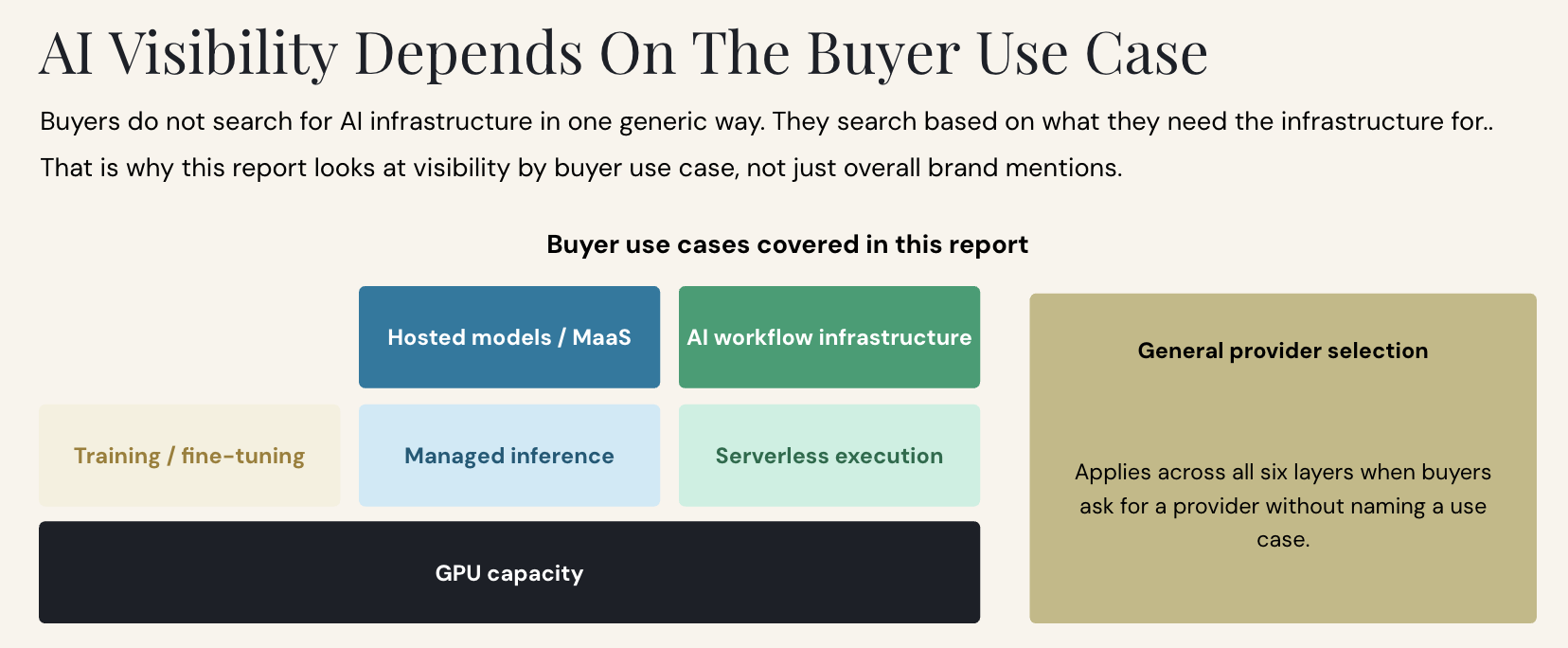
Buyers do not search for AI infrastructure in one generic way. They search based on what they need the infrastructure for. That is why this report looks at visibility by buyer use case, not just overall brand mentions. The diagram below shows how general provider selection sits across the six specific use-case layers.
| Buyer use case | Leading provider | Visibility |
|---|---|---|
| AI workflow infrastructure | Lambda Labs | 73.9% |
| GPU capacity | CoreWeave | 82.5% |
| General provider selection | CoreWeave | 78.3% |
| Hosted models / MaaS | Together AI | 77.5% |
| Managed inference | Together AI | 66.7% |
| Serverless execution | RunPod | 91.3% |
| Training / fine-tuning | RunPod | 69.6% |
Visibility = share of matching prompts in that use case that mention the provider. Leaders are determined across all tracked providers.
Section 02
Purchase Criteria
Buyers do not evaluate infrastructure on one axis. They ask about cost, performance, reliability, security, model fit, and availability. This view shows which providers surface most often for each decision criterion in the current filtered data.
Capacity / availability
Cost
Ease / time-to-value
Hardware fit
Model / workload fit
Overall fit
Performance
Reliability / production readiness
Security / control
Section 03
Buyer Journey Stage
Visibility is not uniform across the buying process. Within the current filters, appearing in problem exploration means AI introduces a provider early. Appearing in provider comparison means AI places a provider in a shortlist. Both matter - but for different reasons.
Problem / job exploration
Buyer is framing the need - broad questions like “what GPU cloud should I use for training?”
Provider comparison
Buyer is evaluating named options - asking how specific providers compare.
Provider discovery
Buyer is identifying vendors - asking which providers exist for a given use case.
Solution / category discovery
Buyer is exploring approaches - understanding serverless vs. dedicated, MaaS vs. raw compute.
Section 04
Source Influence
AI answers are shaped by the sources AI engines draw on. The breakdown below shows which source categories are cited most in the currently filtered AI infrastructure answers.
More citations from a source category does not always mean more visibility for a provider. What matters is whether the right sources reinforce your positioning in the contexts where buyers are asking.
| Category | Source role | Share | Definition and examples |
|---|---|---|---|
| AI INFRASTRUCTURE PROVIDERS | COMPETITORS | 28% | Direct competitors talking about other AI infrastructure providers |
| OWN WEBSITE | SELF | 20% | Brand talking about itself |
| AI Software Platform | ADJACENT | 14% | Software platforms for deploying, managing, routing, monitoring, or operating AI workloads above the infrastructure layer |
| UGC & Knowledge Communities | INDEPENDENT | 12% | User and community discussions on YouTube, Reddit, GitHub, and similar forums |
| AI Applications and Vertical Software | ADJACENT | 7% | Applications and vertical software companies that may be customers, partners, or adjacent competitors to AI infrastructure providers |
| Agency & 3rd-Party | INDEPENDENT | 7% | Independent blogs, agencies, consultants, and services firms that do not fit another category |
| Others | INDEPENDENT | 4% | Sources that do not clearly fit another source category |
| Directories & Reviews | INDEPENDENT | 4% | Review, comparison, directory, marketplace, and pricing sites |
| Analyst, Media & Research | INDEPENDENT | 3% | Trade publications, analyst research, media coverage, and PR sources |
| Hyperscaler / Big Tech | ADJACENT | 1% | Large cloud and AI platforms |
Section 05
AI Engine Comparison
The selected buyer prompts are compared across the selected AI engines. The top providers differ by engine - some names appear consistently, others are specific to one engine's knowledge and training. Same questions, different answers.
ChatGPT
gpt-5.6-luna
Claude
claude-sonnet-5
Gemini
gemini-3.5-flash-lite
Section 06
Overall Visibility
Provider rankings for the same filtered dataset used throughout the report. Each row shows overall visibility, the prompt count behind it, and the selected AI engines contributing to that visibility.
Frequently asked questions
- Why does AI visibility matter for infrastructure providers?
- B2B infrastructure buyers increasingly start their research with AI. Instead of searching a directory or calling a trusted contact, they open ChatGPT or Claude and ask which GPU cloud to use for training, which inference platform handles their model size, or which provider fits their security requirements. If you are not mentioned, you are not on the shortlist - regardless of how good your product is.
- What exactly is "AI visibility"?
- Visibility is the share of relevant buyer prompts in which a provider is named. A provider with 40% visibility appears in 40 out of every 100 prompts buyers ask in that category. It is a presence metric, not a sentiment or quality score. A provider with 5% visibility is largely absent from AI-mediated buyer research.
- How is visibility different from a citation count?
- A provider can be cited many times in a single AI response and still have low visibility if it appears in only a few prompts. Visibility counts the share of unique prompts in which the provider is mentioned at least once. Citation count inflates with response length; visibility reflects actual coverage across buyer questions.
- Why do visibility scores differ across ChatGPT, Claude, and Gemini?
- Each AI engine has different training data, knowledge cutoffs, retrieval mechanisms, and weighting of sources. A provider that dominates ChatGPT responses may score much lower in Claude or Gemini. Consistent visibility across all three engines is the stronger signal - it indicates the provider's positioning is well-established across independent knowledge bases.
- What buyer use cases does this report cover?
- The report covers seven infrastructure buying needs: GPU capacity, training and fine-tuning, managed inference, serverless execution, hosted models and MaaS, AI workflow infrastructure, and general provider selection. Each use case reflects a distinct buyer intent, and visibility leaders vary significantly between them.
- What does it mean if my provider has low visibility?
- AI engines are not including you in buyer research conversations for those prompts. Buyers asking which GPU cloud to use for training are not seeing your name - even if you are a strong option technically. Low visibility at the discovery stage typically means the buyer never reaches the evaluation stage with you in the comparison set.
- Can AI visibility be improved?
- Yes. Visibility improves when you know which buyer questions matter, where your brand is absent, and which sources need to support your positioning. The signals AI engines use include third-party content, community discussions, independent directories, and technical documentation. A high citation count from your own website alone is typically not enough.
- How is visibility calculated in this report?
- Visibility = the share of applicable prompts in which the provider is mentioned at least once in any AI response. For example, if a provider appears in 82 of 202 prompts, its visibility is 40.6%. Each prompt is counted once per provider, regardless of how many times the provider is mentioned within that prompt's response.
- Why do some well-known providers have lower visibility than expected?
- Visibility is prompt-specific. A provider may be well-known in the industry but not appear in AI answers for certain buyer use cases or journey stages. Common causes include: limited third-party coverage for specific use cases, absence from community discussions in that space, or positioning that AI engines do not associate with particular buyer needs.
- How often is this report updated?
- This is a point-in-time snapshot from September 2026. AI engine responses change as training data is updated, new models are released, and the information landscape shifts. Value AI Labs publishes updated editions as new data becomes available. Visibility rankings can shift meaningfully between editions.
Not seeing the visibility you expected?
Value AI Labs can assess exactly which buyer prompts you are missing, which sources are suppressing your visibility, and what to fix first. One conversation, no commitment.
Request an AI visibility audit →